Which Birds to Observe in Uganda?
With more than 1,100 bird species recorded across the territory, Uganda is considered one of the world's best destinations for birdwatching.
With more than 1,100 bird species recorded across the territory, Uganda is considered one of the world's best destinations for birdwatching. Since it's impossible to mention them all, we've put together a list of the most remarkable birds to observe during a birdwatching safari in Uganda.
1. The Crowned Crane

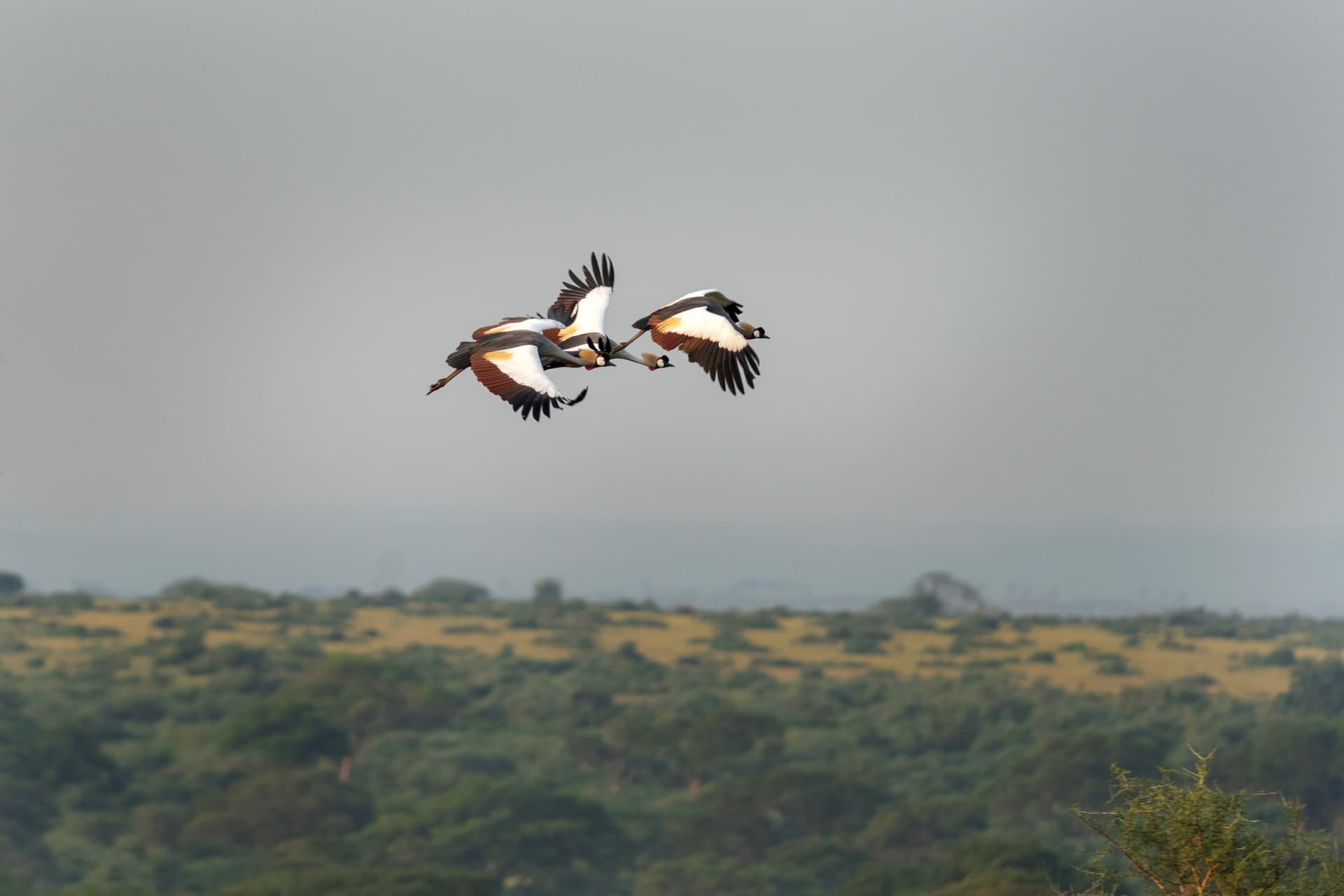
Uganda's national symbol since British colonial times, the Crowned Crane is a species of large wading bird belonging to the Gruidae family. It is characterized by grey plumage, white, yellow and brown wings, a black head topped with a crown of golden feathers, and a red throat pouch. Standing nearly one meter tall, it has long legs and a long hind toe that allows it to grip branches. It is, in fact, the only species of its kind capable of perching on a tree.
Another important fact: it is a resident bird. In other words, this species does not migrate and can be observed year-round during a birdwatching safari.
Where to see the Crowned Crane in Uganda?
Although fairly common in Uganda, the Crowned Crane has been classified as endangered since 2012 due to habitat degradation. It is found mainly in open grasslands and wetlands. To observe it, head to Queen Elizabeth National Park, Kidepo Valley National Park, or near Bigodi Swamp, the Lake Victoria and Lake Bunyonyi.
Why is the Crowned Crane Uganda's national symbol?
Considered the national symbol, the Crowned Crane appears on Uganda's coat of arms and flag, where it is depicted standing on one leg, facing the flagpole. It has held this title since British colonial times, when Ugandan soldiers wore the Crowned Crane as a military insignia. Why? Because it symbolizes prosperity and represents the nation's values. Indeed, this bird is renowned for being resourceful and intelligent.
2. The Shoebill

With its prehistoric appearance and status as a rare and exceptional bird, the Shoebill ranks among the most sought-after birds during a birdwatching safari in Uganda. This bird is endemic to Africa and is the only wading bird in the Balaenicipitidae family.
Also called the "shoe-billed stork" or "whale-headed stork," it is characterized by a large bulbous bill to which it owes its various names. It has plumage in various shades of grey (light grey, dark grey, bluish-grey...) and long legs that allow it to reach a height of about 1.2 meters.
Where to see the Shoebill in Uganda?
Threatened by habitat destruction, the Shoebill is classified as vulnerable by the IUCN. Uganda is one of the countries where the highest numbers are found, making it one of the best destinations to observe this species. The Shoebill lives primarily in wetlands, whether marshes, swamps or lakes. In Uganda, it can easily be observed year-round at Mabamba Swamp, at Lake Albert and around Lake Victoria. It is also found at the Ziwa Rhino Sanctuary and Murchison Falls National Park.
3. The Great Blue Turaco

Also known as the Giant Turaco, the Great Blue Turaco belongs to the Musophagidae family. Measuring up to 75 cm, it is the largest of all turacos. With its magnificent blue-green plumage, elegant crest and yellow bill with red tip, it is one of Africa's most beloved birds among naturalists.
It is a common bird easily spotted in Uganda. It is known for its loud and raucous calls that can be heard from several kilometers away. In Africa, it is considered a symbol of love, peace and good fortune.
Where to see the Great Blue Turaco in Uganda?
The Great Blue Turaco is not considered a threatened species. It primarily frequents tropical forests and forest patches where it likes to take refuge in the treetops. You may also spot it in towns that have large trees and fruit trees. You can see the Great Blue Turaco year-round in Uganda, notably at Bwindi Impenetrable National Forest Park, in Kibale Reserve, in Bigodi Swamps, or in the Entebbe Botanical Garden.
Good to know:
During a birdwatching safari in Uganda, you may also spot other turaco species such as: the Black-billed Turaco, the White-crested Turaco, Hartlaub's Turaco or the Rwenzori Turaco.
4. The Green-breasted Pitta

The Green-breasted Pitta (also called "Reichenow's Pitta") is a passerine species belonging to the Pittidae family. It is one of the most appreciated birds among photographers due to its sublime colors: green on the breast, black bands across the eyes, bluish touches on the wings, a bright red belly and rump...
Although fairly common in Uganda, it is difficult to observe. Indeed, it is a rather discreet bird that camouflages itself easily within dense vegetation. To have a chance of seeing it, we recommend enlisting the help of a local guide specializing in birdwatching safaris. It's worth noting that you may spot it more easily during the breeding period, when you can hear it emit loud calls and whistles that help to locate it.
Where to see the Green-breasted Pitta in Uganda?
The Green-breasted Pitta is a common species in Uganda's forested areas. You can observe it year-round in Kibale Reserve, Maramagambo Forest and Queen Elizabeth National Park. It can also be found in certain parts of Bwindi National Park and along the Albertine Rift Valley.
5. Grauer's Broadbill
Grauer's Broadbill is a passerine species belonging to the Eurylaimidae family. It is a rare bird endemic to the Albertine Rift region. Indeed, it is found only in the tropical forests and wooded areas of two countries in the world: Uganda and the Democratic Republic of the Congo.
With a rotund appearance, it is characterized by magnificent plumage that is predominantly green. Its throat and cheeks are light blue while its chin is white and its forehead rather beige.
Where to see Grauer's Broadbill in Uganda?
In Uganda, Grauer's Broadbill can only be observed in the Bwindi Impenetrable National Forest Park where it is subject to protection measures. This is because its range is highly restricted and threatened by deforestation, and it has been listed as vulnerable on the IUCN Red List of Threatened Species since 2009. To see it, we strongly recommend enlisting the help of an experienced local guide to increase your chances of spotting it.
6. The Carmine Bee-eater and the Northern Carmine Bee-eater

The Carmine Bee-eater and the Northern Carmine Bee-eater are two species belonging to the Meropidae family. Renowned for their sublime colorful plumage, these are birds particularly appreciated by photographers.
Once considered identical species due to their similarities, they are today two distinct species because of differences in their ranges and physical characteristics. To distinguish them, it is enough to look at the colors of their heads: the Carmine Bee-eater has blue-green plumage while the Northern Carmine Bee-eater's head is carmine red (except for the crown which is blue-green).
Where to see the Carmine Bee-eater and the Northern Carmine Bee-eater in Uganda?
These two bee-eater species frequent savannas, open and semi-open woodlands, and nest in colonies near waterways. It is not uncommon to see them perched on the backs of large animals such as antelope and giraffes. In Uganda, you can see the Carmine Bee-eater and the Northern Carmine Bee-eater at Murchison Falls National Park.
7. The Abyssinian Ground Hornbill

Also known as the Abyssinian Ground Hornbill, the Abyssinian Ground Hornbill is one of two species in the Bucorvidae family (the other being the Southern Ground Hornbill). It is among the world's largest hornbills. It is characterized by iridescent black plumage, white primary flight feathers, eyes surrounded by bare blue skin, a red and blue throat pouch, and a large curved black bill.
Known for their resounding calls, it is an amusing bird to listen to and observe during a birdwatching safari in Uganda. Although it is a terrestrial bird, it is capable of flying to perch in a tree.
Where to see the Abyssinian Ground Hornbill in Uganda?
The Abyssinian Ground Hornbill primarily lives in savanna and grassland areas with low vegetation for better ground hunting. It is found in most of Uganda's national parks, especially Kidepo Valley National Park, Queen Elizabeth National Park and Murchison Falls National Park.
8. The Standard-winged Nightjar

The Standard-winged Nightjar is a bird species from the Caprimulgidae family. It ranks among the most beautiful specimens to observe during a birdwatching safari in Uganda. It is a migratory bird that can be observed during the dry seasons, from December to March.
Its particularity? It displays striking sexual dimorphism during the breeding period. Indeed, males acquire wing projections that can reach a length twice that of their body. These fall off or eventually break after the breeding season. Watching them fly with their long wings is a most fascinating spectacle.
Where to see the Standard-winged Nightjar in Uganda?
The Standard-winged Nightjar's range in Uganda is limited to the northwestern region of the country. It is found in open wooded environments such as savannas, grasslands and marshy banks. In Uganda, you can particularly observe it at Murchison Falls National Park.
Want to learn more about Uganda's birds? Discover the best places to observe birds in Uganda. And if you'd like to organize a birdwatching safari, don't hesitate to contact us. We can organize a tailor-made trip and suggest itineraries with local guides specializing in ornithology.
Frequently asked questions
Uganda offers bird observation year-round thanks to its many resident species such as the Crowned Crane and the Shoebill. The best periods are the two dry seasons: June to August and December to February. These periods also allow you to observe migratory species like the Standard-winged Nightjar.
Uganda is home to more than 1,100 recorded bird species across its territory, making it one of the world's best birdwatching destinations. This wealth is explained by the diversity of habitats: tropical forests, savannas, wetlands, lakes and marshes.
The Shoebill can be observed year-round in Uganda, primarily at Mabamba Swamp (one of the world's best sites), around Lake Victoria, at Lake Albert, at the Ziwa Rhino Sanctuary and at Murchison Falls National Park.
It is highly recommended to hire a local guide specializing in ornithology to optimize your observations, particularly for discreet species like the Green-breasted Pitta or rare species like Grauer's Broadbill. An experienced guide knows the habitats, behaviors and best observation times for each species.
The Crowned Crane became Uganda's national symbol during British colonial times, when Ugandan soldiers wore it as a military insignia. It represents prosperity, intelligence and national values. It now appears on the country's flag and coat of arms, depicted standing on one leg, facing the flagpole.
Among the rarest species, Grauer's Broadbill is particularly difficult to observe as it is found only in Uganda and the Democratic Republic of the Congo, exclusively in Bwindi Impenetrable National Forest Park. The Shoebill, classified as vulnerable by the IUCN, is also highly sought after by birdwatchers worldwide.