Uganda: Encounter with the Last Mountain Gorillas
Meeting the mountain gorillas is a fascinating experience that will remain etched in your memory forever.
Meeting the mountain gorillas is a fascinating experience that will remain etched in your memory forever. Threatened with extinction, they are found only in the region of the African Great Lakes. We invite you to journey to the Bwindi Impenetrable Forest National Park in Uganda to discover these great primates in their natural habitat. Discover everything you need to know to organize a trekking expedition to observe the last mountain gorillas…
The Last Mountain Gorillas
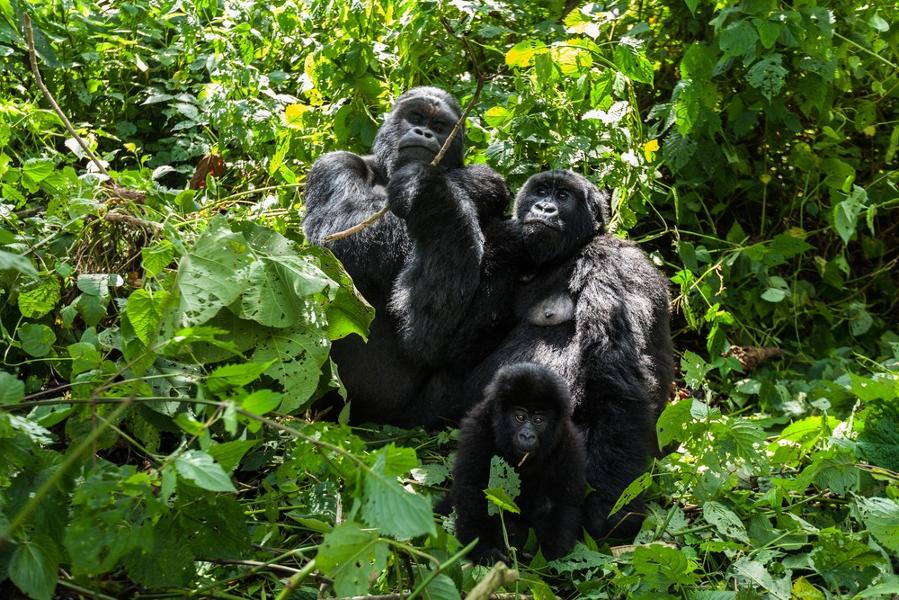
The mountain gorilla is one of the most fascinating great primates. And for good reason—they impress with their sheer size: they can reach up to 2 meters tall and weigh up to 300 kg for males. Despite their imposing stature and colossal strength, mountain gorillas are shy and peaceful animals, far from the image portrayed in certain films. They live in communities within groups ranging from 5 to 50 individuals. Each group is dominated by a male, the famous "silverback."
Mountain gorillas are found only in the region of the African Great Lakes and more specifically in the humid forests of the Virunga volcanic chain on a territory extending from the Democratic Republic of the Congo (DRC), to Uganda and Rwanda. They thus find refuge in high-altitude forests, up to 4,000 meters above sea level. Unfortunately, due to poaching threats and deforestation, these incredible primates are among the great ape species in danger of extinction. The good news? Thanks to effective conservation measures and the contribution of local communities, mountain gorilla populations are rebounding. Indeed, only 620 individuals were counted in 1998 compared to 1,063 in 2020.
Observing Gorillas in Bwindi Impenetrable Forest
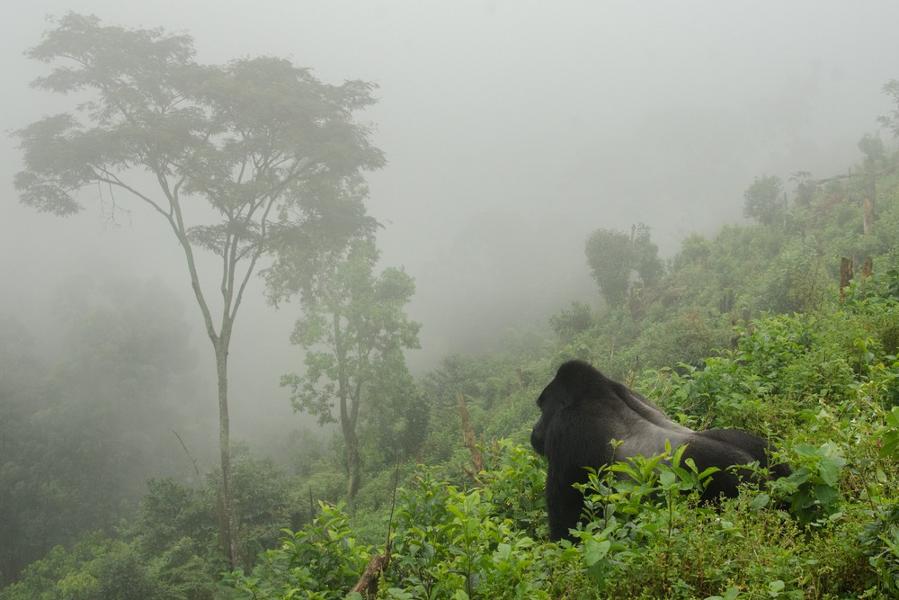
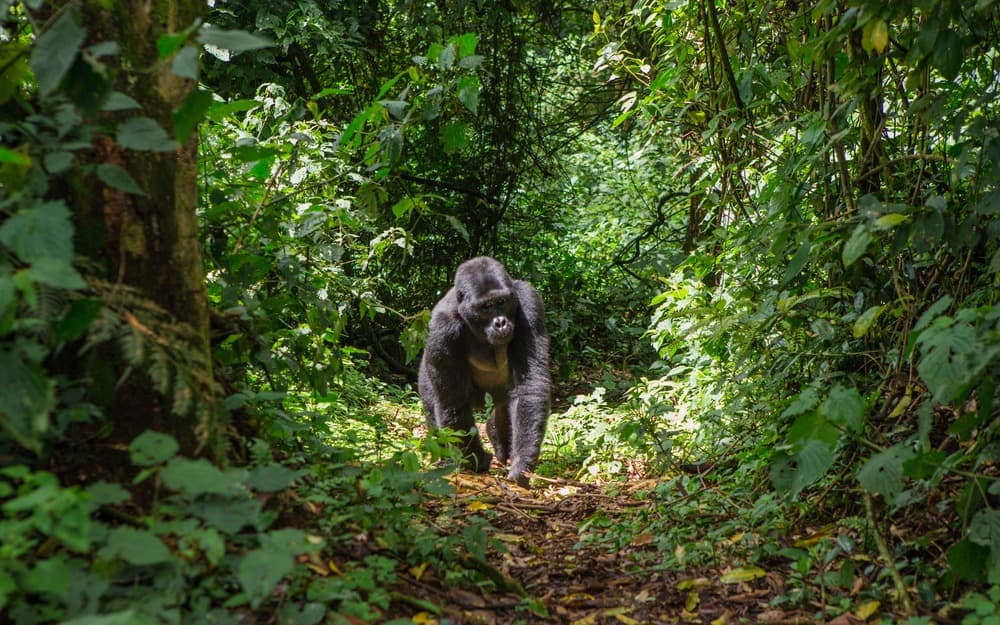
To observe mountain gorillas on Uganda's side, head to the southwest of the country in the magnificent Bwindi Impenetrable Forest National Park. It is here, across 32,100 hectares of lush forests, that you will find half of the world's remaining mountain gorilla population. This is the ideal place to embark on an adventure for a trek to meet the gorillas and observe these impressive primates thriving in their natural habitat. Approximately 35 groups of mountain gorillas are documented here, some of which have become accustomed to human presence, such as the Mubare and Katendegyere groups. To encounter them, several options are available to you. You can start from four different trailheads: Ruhija, Nkuringo, Rushaga, and Buhoma.
Beyond the mountain gorillas, Bwindi Impenetrable Forest National Park is home to other large mammals such as chimpanzees, L'Hoest's monkey, and African elephants. You will also find 347 bird species and 220 butterfly species. The hikes following the mountain gorilla trails (and other animals) will take you across sometimes difficult terrain where you alternate between jungles and undergrowth, valleys and steep ridges. There is no doubt—this is the perfect place to set off on an adventure and treat yourself to an immersion deep in the African jungle.
What You Need to Know During the Trek (Safety and Guidelines)
First and foremost, be aware that you must obtain a gorilla permit if you wish to undertake a safari in Uganda to get up close with our closest cousins after chimpanzees and bonobos. The gorilla permit costs approximately 700 USD. This permit is issued for 4 sectors distributed across the entire Bwindi park and not for a specific gorilla group.
Once your permit is secured, you will be accompanied by a qualified guide from Uganda Wildlife Authority. They will explain all the guidelines you need to know to enjoy your expedition among the gorillas safely while ensuring their protection. Among the essential rules to remember: you will not be able to spend more than one hour with a gorilla group once contact is established. To ensure their protection, the safety distance is set at 7 meters. To prevent the spread of bacteria and disease, it is forbidden to undertake a trek to meet the gorillas if you are sick or if you show any symptoms. Finally, flash photography is strictly prohibited so as not to disturb the gorillas' peace.
For the rest, simply let yourself be guided by your guide, who will be there to answer all your questions and allow you to fully enjoy this unique moment that, we are certain, will mark you forever!
Do you dream of seeing the last mountain gorillas up close? Discover our Lake Victoria to Bwindi Gorillas tour or our Uganda Primate Encounters tour.
Frequently asked questions
The gorilla permit in Uganda costs approximately 700 USD per person. This permit is valid for one outing in one of the 4 sectors of Bwindi Impenetrable Forest National Park (Ruhija, Nkuringo, Rushaga, or Buhoma) and not for a specific gorilla group. It is advisable to reserve well in advance, as places are limited.
The best times to observe mountain gorillas in Bwindi park are the dry seasons: from June to August and from December to February. The trails are less muddy and hiking conditions are more pleasant. That said, trekking is possible year-round, and the rainy season offers a particularly lush forest.
The duration of a trek to observe gorillas in Bwindi park varies depending on the location of the gorilla group that day: it can range from 1 to 6 hours of walking one way. Once the group is located, you can only remain in their presence for a maximum of one hour—a strict rule imposed for their protection.
Yes, a reasonable level of physical fitness is recommended for the Bwindi gorilla trek. The terrain can be difficult, with steep climbs and descents in dense and sometimes humid jungle. Walking poles are recommended. People with mobility issues should inform their guide in advance.
There were 1,063 mountain gorillas in the world in 2020, compared to only 620 in 1998. This increase is the result of significant conservation efforts involving the Ugandan, Rwandan, and Congolese governments as well as local communities. Half of this population lives in Bwindi Impenetrable Forest National Park in Uganda.