Where to see chimpanzees in Uganda?
While renowned for gorilla watching, Uganda is also the premier destination for those who wish to observe chimpanzees in their natural habitat.
While renowned for gorilla watching, Uganda is also the premier destination for those who wish to observe chimpanzees in their natural habitat. For this, head to Kibale National Park! A true kingdom of primates, you can undertake a trek to encounter them and observe their way of life accompanied by a guide. Discover what you need to know to observe these primates considered to be mankind's closest relatives…
Kibale Forest, world capital of primates
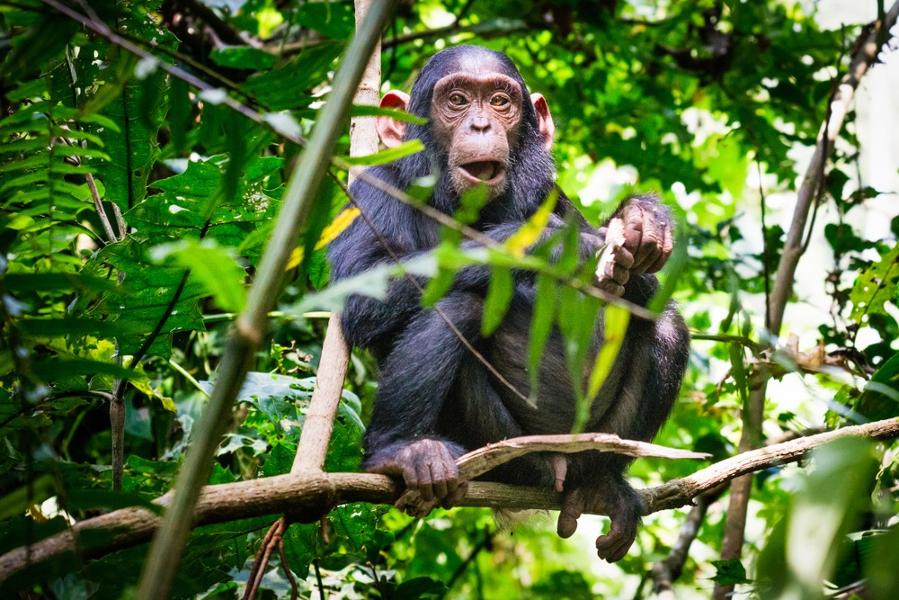
Located in the western part of Uganda, Kibale National Park is considered the world capital of primates. Indeed, it is home to one of the densest populations of primates in the world with 13 recorded species: the Anubis baboon, the Ascagne cercopithecus, the L'Hoest's cercopithecus, the Central African red colobus, the eastern black-and-white colobus, the grey-cheeked mangabey, the blue monkey, the tantalus monkey, the spectacled galago, Demidoff's galago, Thomas's galago, the potto and the famous chimpanzee.
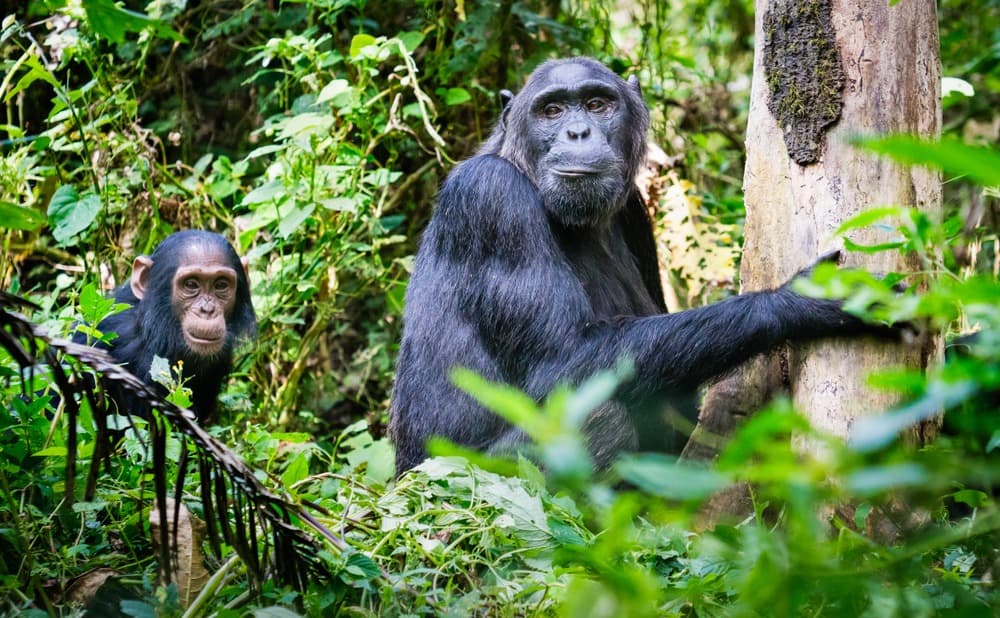
It is precisely to encounter chimpanzees that Kibale Forest is renowned throughout the world! Indeed, there are three groups of chimpanzees "habituated to humans" that you can meet during a trek. Furthermore, it is the idyllic place to observe chimpanzees in the wild in their natural environment without disturbing them too much. An unforgettable experience that you won't forget anytime soon!
Trekking to meet chimpanzees in Kibale Forest
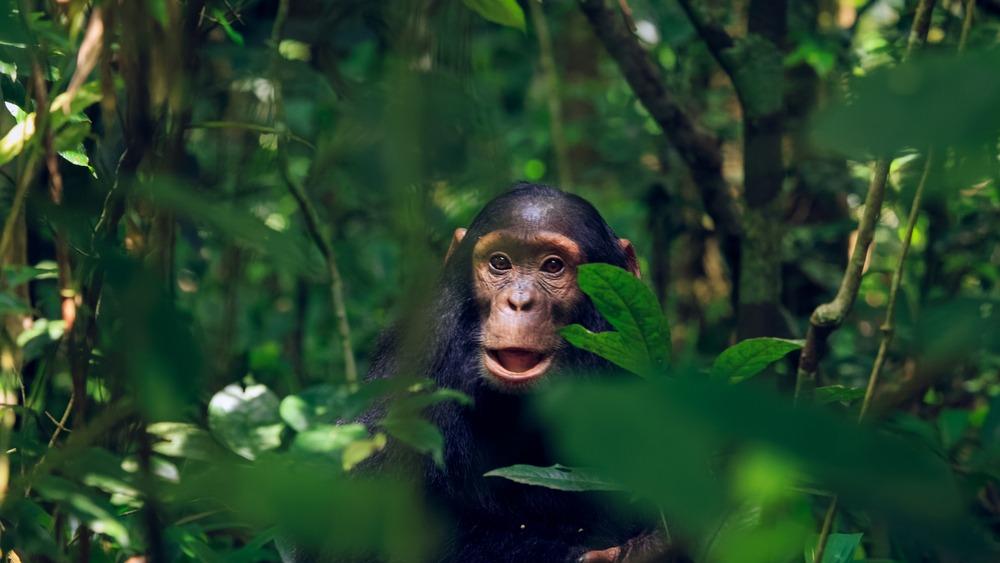
To encounter the chimpanzees of Kibale Forest, departures take place from Kanyanchu. Accompanied by a guide, you can trek on the trails of these primates (with whom we share over 98% of our DNA in common!) within a group of six individuals. Once your guide has made contact with chimpanzees, you will have only one hour to observe them. Indeed, although they are habituated to us, human presence is limited to a maximum of one hour in order to minimize disturbance.
During this time and always with the aim of avoiding disturbing the chimpanzees, it is forbidden to make noise and to approach them closer than eight meters. To avoid contaminating them, it is also prohibited to participate in a trek if you are ill. If you wish to spend more time with the chimpanzees, know that there is a program allowing you to participate in the chimpanzee habituation sessions named "Chimpanzee Habituation Experiment".
Note: to undertake a trek to meet chimpanzees, you must obtain a park entry permit. Called "Chimpanzee Tracking", this costs 150 USD (park entry permit included) for non-resident foreign nationals. Our English-speaking team will handle all the procedures to make your stay easier. Discover in particular our Encounter with the Primates of Uganda circuit for the chance to trek in Kibale National Park to observe chimpanzees. For any further information, please do not hesitate to contact us and request your free quote.
Frequently asked questions
Kibale Forest can be visited year-round, but the best periods are the dry seasons (June-August and December-February), when the trails are passable and chimpanzees are easier to locate. Less dense vegetation during the dry season also facilitates observations.
The 'Chimpanzee Tracking' permit, which includes entry to Kibale National Park, costs 150 USD per person for non-resident foreign nationals. It allows you to observe chimpanzees for a maximum duration of one hour in a group of 6 people.
Once your guide has made contact with a chimpanzee group, you have a maximum of one hour to observe them. This limit is imposed to reduce the disturbance caused by human presence. If you wish to spend more time with them, the 'Chimpanzee Habituation Experiment' program is an option.
Yes, Kibale National Park is home to 13 species of primates, including the Anubis baboon, the Ascagne cercopithecus, the grey-cheeked mangabey, the eastern black-and-white colobus, the galago and the potto. It is one of the highest densities of primates in the world.
Yes, several strict rules apply: you must not make noise, approach closer than 8 meters to chimpanzees, and you cannot participate in the trek if you are ill (to prevent any contamination). Observation is limited to 1 hour per group of a maximum of 6 people.
The 'Chimpanzee Habituation Experiment' is a special program that allows you to spend more time with chimpanzees than during a classic trek. You accompany researchers and guides in the process of habituating new chimpanzee groups to human presence. This program is ideal for travelers seeking an in-depth immersion.