Rwenzori Mountains National Park
Rwenzori Mountains National Park
The Rwenzori Mountains, inscribed on the UNESCO World Heritage list, are home to Africa's third-highest peak and spectacular afroalpine vegetation: giant groundsels, lobelias and high-altitude glaciers create an unforgettable landscape.
The Rwenzori Mountains rise along the border between Uganda and the Democratic Republic of Congo, forming one of Africa's most spectacular mountain ranges. Listed as a UNESCO World Heritage site, they are home to the continent's third-highest peak, Margherita Peak (5,109 m), and unique high-altitude vegetation: giant heathers, tree groundsels and lobelias create a landscape without parallel on the continent.
Essential information at a glance
- Entry: paid — trekking permit issued by the Uganda Wildlife Authority (UWA)
- Access: from Kasese, the nearest town, connected to Kampala by road and train (irregular service)
- Recommended duration: standard circuit 7-8 days to reach the summit; shorter treks also possible (2-3 days)
- Gear: mountain equipment essential — waterproof jacket, thermal layers, gaiters; trails are muddy year-round
- Guides and porters: mandatory for all park treks, provided via UWA or approved operators
- Accessibility: not adapted for persons with reduced mobility — demanding alpine terrain
What you'll see
The national park covers approximately 1,000 km² of afromontane forests, alpine moorlands and rapidly retreating glaciers. Vegetation zones succeed one another with altitude: dense tropical forest, bamboo groves, moss-covered tree heathers, then the afroalpine zone with its characteristic giant plants. The summit glaciers, though significantly reduced by climate change, remain visible from the upper ridges.
History and context
The Rwenzori are identified by some historians as the legendary "Mountains of the Moon" mentioned by Ptolemy in the 2nd century. Explorer Henry Morton Stanley sighted them in 1888 — clouds usually obscure them from view. The first ascent of Margherita Peak was accomplished in 1906 by the Duke of the Abruzzi. The park was inscribed on the UNESCO World Heritage list in 1994.
Highlights of the visit
Margherita Peak
The summit of the Rwenzori at 5,109 m is the objective for experienced trekkers. The final ascent requires basic mountaineering equipment (crampons, ice axe) and proper acclimatisation. The view over the glaciers and valleys below justifies the effort.
Afroalpine vegetation
Between 3,000 and 4,500 m, giant groundsels (Senecio) reach several metres in height and lobelias form dense columns. This landscape, described as a "prehistoric garden", is one of the most singular visual experiences in East Africa.
Lakes and glacial valleys
The central circuit crosses several high-altitude lakes — including Lake Bujuku — framed by rocky walls. These U-shaped valleys, carved by ancient glaciers, offer spectacular campsites above 3,900 m.
Forest wildlife
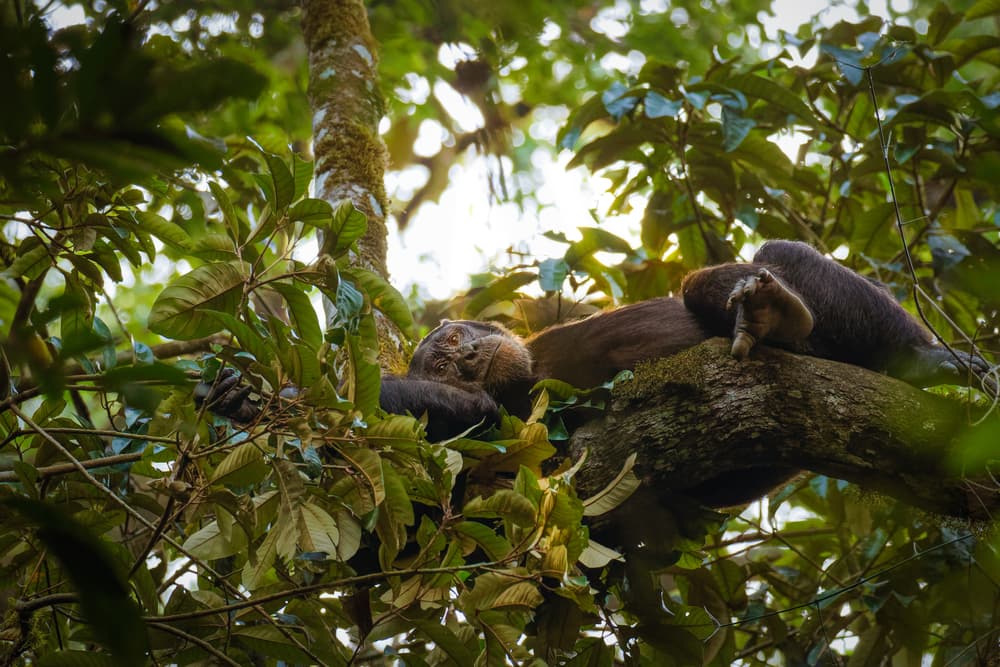
The park's lower forests are home to chimpanzees, black-and-white colobus monkeys, and rich birdlife including several species endemic to the Albertine Rift. Sightings are more frequent early in the trek, in the lower forest zones.
Photography tips
Early morning light (before 9 a.m.) offers the best conditions before clouds cover the peaks — an almost daily occurrence. The giant afroalpine plants photograph well in upward angles to emphasise their height. Bring waterproof covers for your gear: humidity is constant above 3,000 m.
Location and access
The park is located in western Uganda, in the Rwenzori region, near Kasese. The main entrance gate (Nyakalengija) is about twenty kilometres from Kasese. From Kampala, allow approximately 5 to 6 hours' drive. Domestic flights serve Kasese airport from Entebbe irregularly — check availability with a local operator. The park is managed by the Uganda Wildlife Authority; all entry and trekking must be organised via the UWA or an approved operator.
Nearby attractions
- Queen Elizabeth National Park — a few hours to the south, combining savanna safaris, tree-climbing lion viewing and cruises on the Kazinga Channel.
- Lake George — a shallow lake at the gates of Queen Elizabeth park, renowned for fishing and birdwatching.
- Kasese — the logistical departure point for the Rwenzori, with local markets and basic accommodation.
Frequently asked questions
The dry seasons (December-February and June-August) offer the best conditions, but the Rwenzori remain humid year-round. Even in the dry season, expect daily rain and mist above 3,000 m.
Ascending Margherita Peak requires good physical fitness and basic mountaineering equipment (crampons, ice axe). Shorter 2-3 day circuits to the afroalpine zones are accessible to trained hikers without alpine experience.
Yes. The Uganda Wildlife Authority requires all park trekkers to be accompanied by an approved guide. Porters are also available and highly recommended on longer circuits.
Yes, it's a classic itinerary in western Uganda. Both parks are close and complementary: mountain and unique vegetation on one side, savanna safari on the other.
The Rwenzori glaciers have retreated considerably since the 20th century due to climate change. They remain visible from the summit areas, but their extent is diminishing year on year.
Interested in this visit?
We can include it in your personalised itinerary.