Gorilla Trekking
Gorilla Trekking
Nearly half of the world's mountain gorilla population lives in the remote forests of Uganda. Set out in search of them and you'll discover that our closest relatives are truly fascinating creatures.
Nearly half of the world's mountain gorilla population lives in the remote forests of Uganda. Set out in search of them and you'll discover that our closest relatives are truly fascinating creatures.
History
The mountain gorilla was introduced to the world in 1902. Like many of its wild counterparts, the animal was hunted from the moment of its discovery. And as if poaching weren't enough, deforestation and disease dramatically reduced its numbers. The mountain gorilla is now listed among the most endangered great ape species. The last remaining families inhabit the humid forests of the Virunga volcanic chain, which winds through three Central African countries: the Democratic Republic of Congo, Rwanda, and Uganda.
The good news is that thanks to effective conservation measures and the commitment of local communities, populations have been rising in recent years, growing from 620 individuals in 1998 to 1,063 in 2020.
Discovering the Gorillas
Before anything else, know that you must have a gorilla permit to participate in gorilla safaris in Uganda. Head to the Uganda Wildlife Authority in Kampala to obtain one. This will cost you 700 USD.
What Does a Mountain Gorilla Look Like?
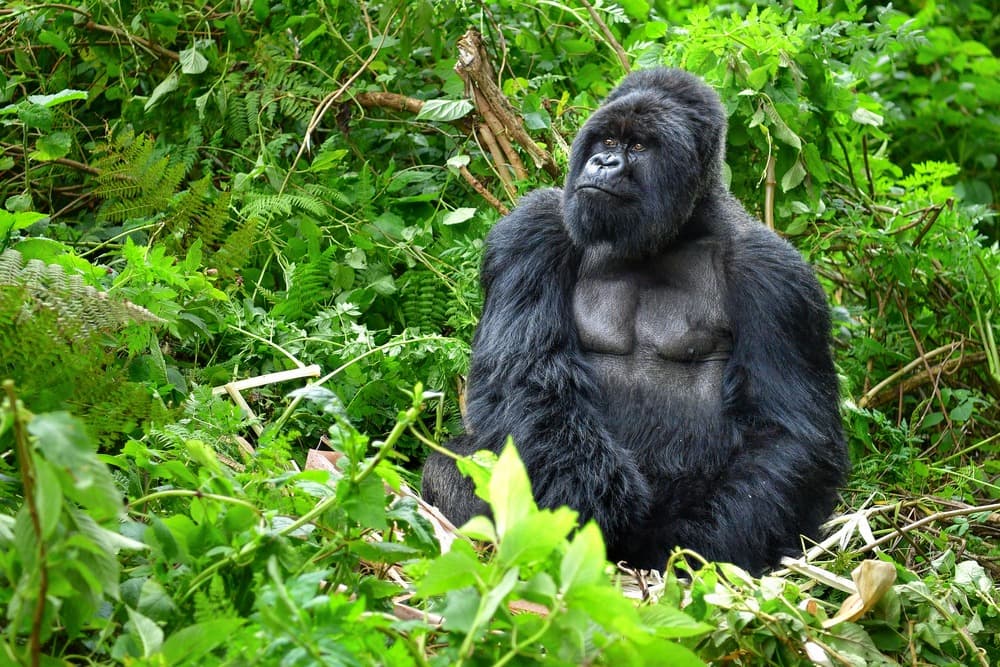
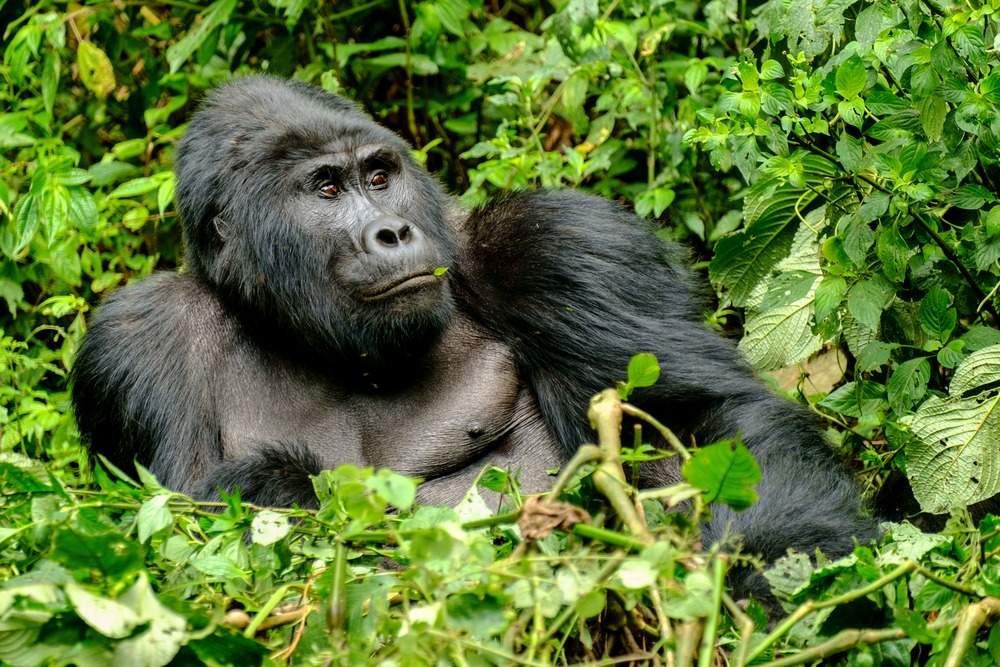
The mountain gorilla is a large primate covered in dense black hair, with a barrel chest and a broad face. Its natural habitat lies in mountainous and subalpine zones, though it also frequents grassy pockets in valley bottoms and isolated clearings. Compared to its lowland cousin, the mountain gorilla has a more restricted diet. Bamboo, stems, and leaves (more than 140 plant species), wild celery, and vines make up its meals. It's a social animal that lives in groups of 5 to 50 individuals. The community is led by a dominant male, the "silverback" (over 13 years old), who may be assisted by other subordinate silverbacks. The leader is respected by all, he eats first, but also has the duty to defend the group against external threats. When he dies, the group disperses.
Prepare Yourself—This Journey Will Be Challenging
Once you have your permit in hand, prepare your expedition kit. The trek takes you over difficult terrain alternating between jungles, valleys, and steep ridges. You may spend hours hacking through dense undergrowth before establishing contact with the primates. The trek becomes even more demanding during the rainy season, as trails become slippery. Because of the equator's proximity, rain can fall at any time.
Choose your clothing carefully so it protects you from the elements (wind, moisture, insects, thorny plants, etc.), while keeping you cool during long hours of walking. Here are some recommended items:
- Long-sleeved t-shirt
- Waterproof jacket
- Lightweight, waterproof trousers
- Hiking boots
- Long socks to wear over your trousers
- Outdoor gloves
You'll receive water bottles during the trek, but still plan for a few electrolyte sachets for quick relief after a long day of hiking. Walking poles are usually provided by your guides.
Where to See Gorillas in Uganda?
Seasoned adventurers will point you toward Bwindi Impenetrable National Park, in southwestern Uganda. Eleven families of gorillas habituated to human contact frequent the reserve. You have the choice of four trailheads to begin your expedition: Ruhija, Nkuringo, Rushaga, and Buhoma. Each route has its own character and challenges.
More remote along the Rwandan border, Mgahinga National Park offers less strenuous treks than Bwindi, but permits are limited. While gorilla families constantly move between Rwandan and Ugandan forests, only one group called Nyakagazi is habituated to human presence at Mgahinga.
Rules to Follow During a Gorilla Trek
Before venturing into the wild forests, pay close attention to your guide's briefing if you want to fully enjoy your encounter with the gorillas, safely. The most important guidelines are as follows:
- Once contact is established, you have one hour to spend alongside these giants. This is the standard duration. If you wish to spend more time with the animals, ask the habituation team to integrate you into their group and enjoy four hours of viewing (Cost of a 4-hour session: 1,500 USD).
- The safety distance is set at 7 meters.
- For photographers, flash photography is strictly forbidden.
- You must be in good physical and mental condition to participate in a gorilla trek. If you feel unwell, you will be turned away.
Expeditions are led by qualified guides from the Uganda Wildlife Authority. Throughout your journey, they introduce you to the forest's ecology and explain the changing landscapes. The guides work with a team of trackers who set out at dawn to locate the gorillas.
When to Go?
Generally speaking, you can undertake a gorilla trek year-round, but keep in mind that the expedition will be more challenging during rainy periods. If we had to pinpoint the best times for a gorilla safari in Uganda, choose dates during the country's two main dry seasons. Though variations can occur due to climate change, Uganda's two traditional dry periods run from January to February and June to September. Also consider price fluctuations depending on the season and tour operators. If you're willing to brave the humidity, rates are more affordable during the rainy season.
Give it a go!
Our local experts arrange this activity for you.