Kidepo Valley National Park
Kidepo Valley National Park
Isolated in the far northeast of Uganda, Kidepo Valley Park offers semi-arid savanna inhabited by lions, cheetahs, and African wild dogs, set within preserved mountain landscapes and rarely visited by mass tourism.
Tucked into the northeastern corner of Uganda, bordering South Sudan and Kenya, Kidepo Valley National Park is one of East Africa's most remote protected areas. Its semi-arid savanna, deep-cut valleys, and mountain landscapes harbour dense wildlife largely undisturbed by mass tourism. Here roam species absent from Uganda's other parks: cheetahs, African wild dogs, striped jackals, and vast buffalo herds.
Essentials at a glance
- Entrance: paid admission — daily permit required, managed by Uganda Wildlife Authority (UWA)
- Access: charter flight from Entebbe or Kampala to Kidepo airstrip; long road journey with partially unpaved sections from Kampala (approximately 700 km)
- Recommended duration: 3 to 5 days to explore the two main valleys
- Dress code: neutral clothing (khaki, beige), hat, sun protection — intense heat during dry season
- Best season: dry season (December–March and June–August) for track accessibility and wildlife concentrations
What you'll see
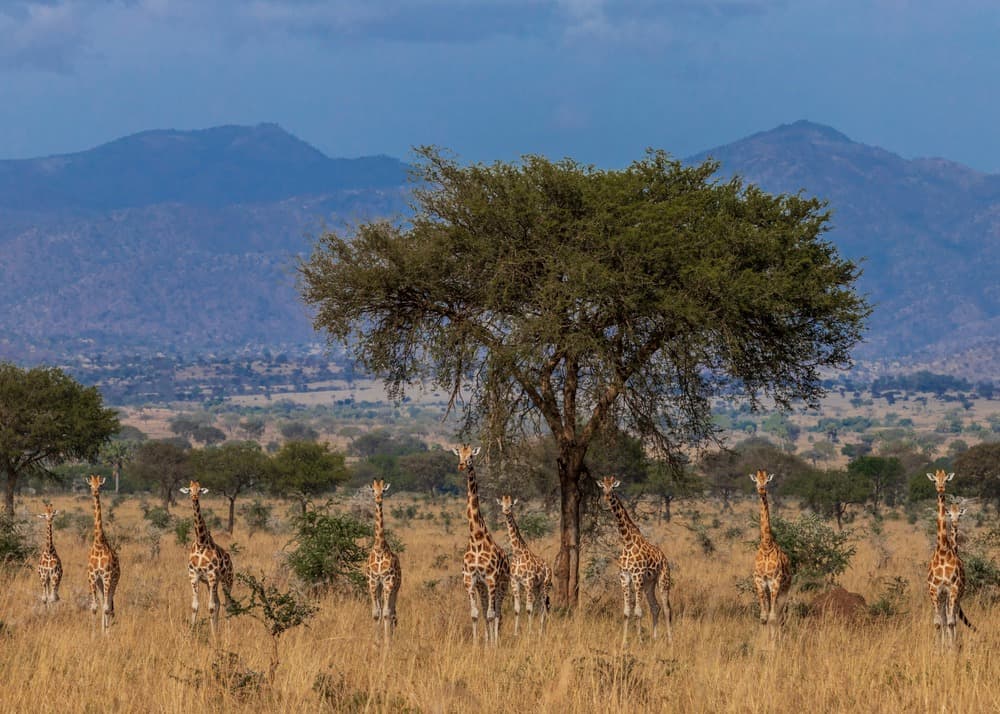
The park encompasses two valleys: Kidepo in the north and Narus in the south. The more humid Narus Valley concentrates wildlife around permanent water sources during the dry season. Lions, elephants, Rothschild's giraffes, Burchell's zebras, oryx, elands, and numerous antelope species gather here. The wilder Kidepo Valley offers mountain scenery with the Morungole Mountains as a dramatic backdrop.
History and context
Kidepo was designated a national park in 1962, the year of Ugandan independence. During decades of regional conflict (1970s–1990s), poaching devastated certain animal populations. Since the 2000s, wildlife numbers have recovered thanks to UWA conservation efforts and involvement from the Karamojong, a semi-nomadic pastoral people who have inhabited the region for centuries.
Highlights of your visit
The lions of Kidepo
The lion population here is among Uganda's densest. Large family groups are easily spotted across the open savanna of Narus Valley, especially in late afternoon.
Cheetahs and African wild dogs
Kidepo is one of the few places in Uganda where you can see both cheetahs and African wild dogs. The endangered wild dogs move in packs and may require several days of safari to locate.
Birdlife
More than 475 bird species have been recorded. Denham's bustard, Abyssinian roller, and various raptors are characteristic of this semi-arid zone.
Karamojong cultural encounters
Villages on the park's periphery offer guided cultural visits. The Karamojong maintain a traditional pastoral lifestyle, with distinctive social structures and ceremonies unique to the region.
Photography tips
Golden light in early morning and late afternoon is ideal in the open savanna. The Morungole Mountains provide rare backdrops for wildlife photography. During the dry season, Narus water points allow for extended game viewing sessions. Avoid flash photography with nocturnal animals during night game drives.
Location and access
The park lies in Kaabong District, within Uganda's Karamoja region, at the country's far northeast. The park headquarters at Apoka serves as the departure point for all game drives. The road from Kampala passes through Gulu and Kitgum — allow a full day and a half of driving on rough tracks. A charter flight remains the most comfortable option. UWA guides are available at Apoka for walking and safari activities.
Nearby destinations
- Murchison Falls — Uganda's other major park, reachable by combining both destinations via Gulu.
- Lake Albert — natural border with the DRC, rift valley scenery and traditional fishing.
- Karamoja region — semi-arid territory of pastoral Karamojong culture, best explored with a local guide.
Frequently asked questions
The dry season (December–March and June–August) is most favourable: tracks are passable and wildlife congregates around water points, making observation easier.
Two options: a charter flight from Entebbe or Kampala to Apoka airstrip (fastest), or the road route via Gulu and Kitgum — long and partially unpaved, requiring a 4x4 vehicle.
Yes, guided game walks are organized from Apoka camp with armed UWA rangers. This offers a different way to experience the savanna's wildlife and flora.
The remoteness and rough tracks make the journey demanding. Vehicle game drives work for older children, but guided walks are restricted to adults under UWA regulations.
Apoka Tourism Centre (managed by UWA) offers bungalows and camping. A few private lodges operate on the park's periphery. Accommodation is limited — book well in advance.
Yes, though remoteness requires careful logistics. The most common combination links Kidepo with Murchison Falls via Gulu, or with Bwindi for gorillas — plan for at least 10 to 14 days.
Photos
Want to discover this destination?
Our local advisors design your tailor-made trip.