Mabamba Swamp
Mabamba Swamp
A 165 km² Ramsar wetland on Lake Victoria's shores, Mabamba is one of the world's premier sites for spotting the Shoebill and 260 bird species.
About thirty kilometers from Entebbe, on a bay of Lake Victoria, Mabamba Swamp stretches across 165 km² of papyrus, water lilies, and shallow channels. This wetland is home to 260 bird species and ranks among East Africa's most accessible sites for observing the Shoebill.
Why visit Mabamba Swamp
Mabamba brings together three compelling advantages for both amateur and seasoned birdwatchers. First, its immediate proximity to Entebbe and the international airport makes it a half-day excursion. Second, observation is conducted by motorized canoe, allowing you to approach wildlife in near silence. Third, the site concentrates a density of aquatic species rarely found in a single wetland, including several Lake Victoria basin specialties.
The swamp is one of 33 Important Bird Areas (IBA) recognized in Uganda. It was also designated in 2006 under the Ramsar Convention as a wetland of international importance.
History and origins
The name Mabamba comes from the Luganda word emamba, which refers to a lungfish (protopterus). According to oral tradition shared by local fishermen, this fish can survive up to three days out of water if regularly sprinkled. For decades, riverside villages subsisted on fishing, in direct competition with the swamp's piscivorous birds. Today, the local economy relies primarily on agriculture and ornithological ecotourism, a shift that has helped ease this tension and protect the area.
Communities also sustainably harvest plant resources from the swamp: bags, baskets, and mats are crafted from reeds and sold in craft shops in surrounding villages.
What to see at Mabamba
The Shoebill
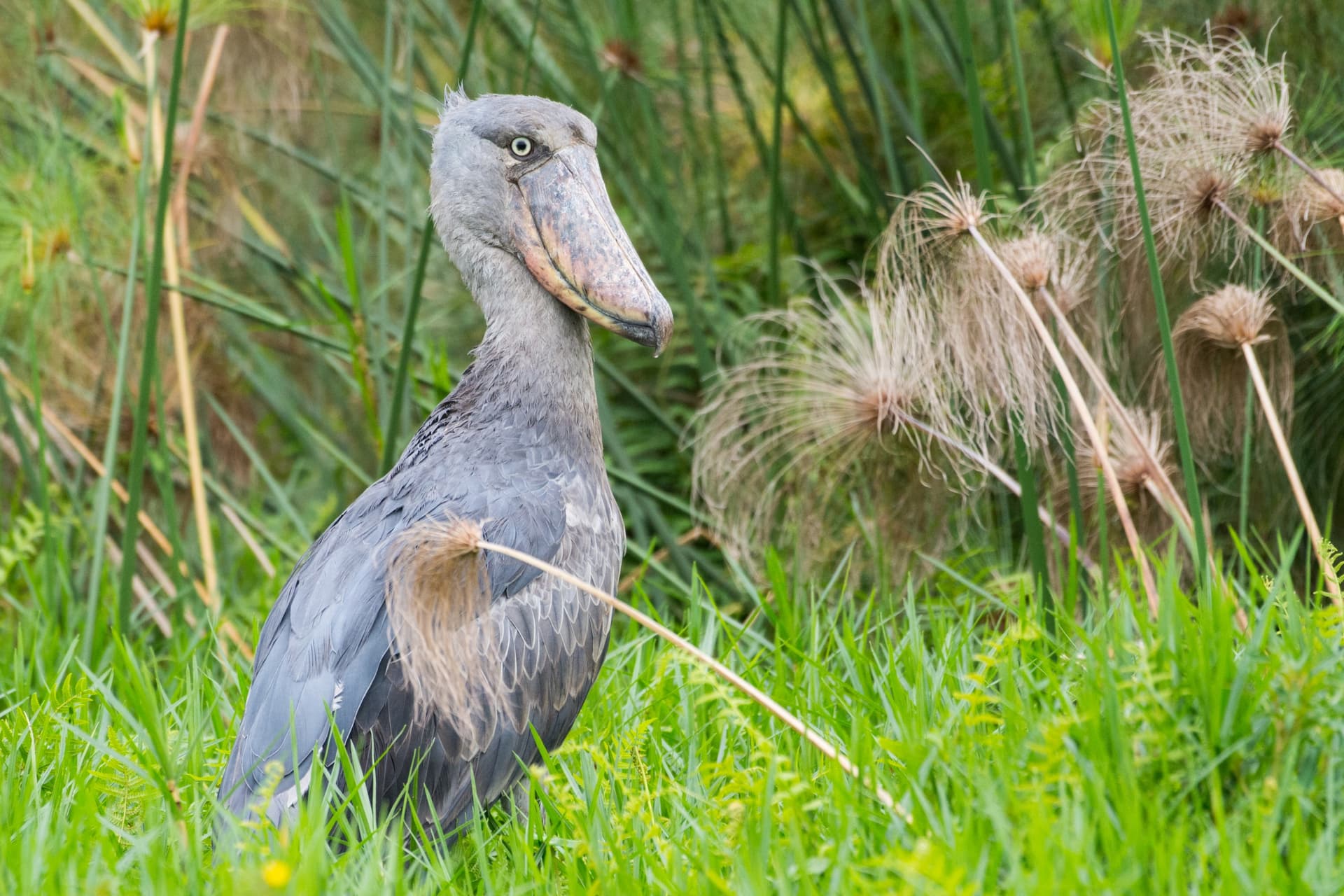
The bird that attracts most visitors is the Shoebill (Balaeniceps rex). Its silhouette is instantly recognizable: a massive bill resembling a pelican's, long legs suggesting a flamingo, an eagle's fixed gaze. Its lineage is ancient, dating back over 60 million years according to paleontologists. The species is classified as vulnerable, and Mabamba remains one of the most reliable sites to observe it in the wild. In Uganda, you may also encounter it at Ziwa Rhino Sanctuary, Murchison Falls National Park, Semliki Reserve, and to a lesser extent Lake Mburo National Park.
Other waterbirds
The swamp offers ideal conditions for observing diverse species along its shores, lily pads, and papyrus thickets:
- Waders: white-winged plover, African jacana, goliath heron
- Pied and crested kingfishers
- Grey pelican, African cormorant, African fish eagle
- Blue-breasted bee-eater, papyrus gonolek
- Ducks and wetland raptors
An East African ornithology field guide is useful for species identification; local guides know their calls and nesting zones.
Butterflies and mammals
The swamp hosts over 200 butterfly species, including Acraea aganice, Acraea consanguinea, Bicyclus sebetus, and Achaea aurivilli. Among mammals, the sitatunga antelope, adapted to marshy terrain through its elongated hooves, is present but elusive. Neighboring forest hills harbor a few primate species.
When to visit
The swamp is accessible year-round, but the dry season (June to August, and December to February) facilitates navigation and observation: calmer waters, clear skies for photography. The rainy seasons (March-May and September-November) coincide with the arrival of Palearctic migratory species, enriching your species list despite sometimes uncomfortable conditions.
For the Shoebill, early morning departures (around 6–7am) significantly improve your chances of spotting it, as the bird is more active during cool hours.
Practical information
Visits are conducted in motorized canoes accommodating three to four people. When a bird is spotted, the boatman cuts the engine and paddles to approach without disturbing wildlife. Allow 1.5 to 2 hours for a standard outing, with the option to extend for an hourly surcharge.
Differentiated entrance fees apply based on status (foreign tourist, resident, Ugandan national), plus the rental of the boat, which includes boatman and guide. Bring:
- Binoculars and telephoto lens if photographing
- Hat, sunscreen, and water
- Neutral-colored clothing and insect repellent
- Waterproof bag for gear
How to get there
From Entebbe
Two options. By road, follow the old Entebbe-Kampala road, branch at Kisubi, then pass through Nakawuka and Kasanje before reaching the swamp. By water, a speedboat journey across Lake Victoria from Entebbe takes about 50 minutes; boats can be rented from certain hotels or the sailing club. Since speedboats cannot penetrate the papyrus, a transfer to a smaller boat occurs upon arrival.
From Kampala
Mabamba lies approximately 57 km from the capital. A shared taxi connects Kampala to Kasanje, from where a boda boda (motorcycle taxi) covers the final kilometers to the swamp. Alternative: the Masaka road to the Buyege junction, then direction Mabamba.
What to combine in the region
- Entebbe: the country's gateway, ideal for a night before or after the birdwatching excursion.
- Entebbe Botanic Garden: another birdwatching site on Lake Victoria's shore.
- Ziwa Sanctuary: on the route to Murchison Falls, a second reliable site for the Shoebill.
- Bigodi Swamp: to the west, a natural complement for wetland and primate enthusiasts.
Frequently asked questions
Frequently asked questions
Early morning, ideally at dawn. The bird is more active during cool hours and low-angle light aids photography.
A standard canoe outing lasts between 1.5 and 2 hours. You may extend your experience for an hourly surcharge if you wish to explore the swamp more thoroughly.
For an organized excursion from Entebbe or Kampala, it's best to reserve the day before through an operator or your accommodation, especially during peak tourist season.
Yes, the motorized canoe outing is accessible to children provided they can tolerate extended periods of sitting still. Life jackets are provided.
No wild site guarantees sightings, but Mabamba remains one of the world's most reliable locations for this species. Local guides know its favorite zones and greatly increase your chances of an encounter.
Prepare your journey
Mabamba Swamp fits naturally into an ornithological circuit or a trip combining major parks and wetlands. To build a custom itinerary including this excursion, explore our Uganda travel packages.
Interested in this visit?
We can include it in your personalised itinerary.